
Anger Management Techniques for Relationships: Healthy Ways to Stop Exploding

Few experiences in life carry as much weight as loving someone deeply, yet finding yourself repeatedly exploding at them over minor misunderstandings.
If you have ever said something hurtful in the heat of the moment, slammed a door, or watched your partner shut down in distress after an argument, you know the heavy guilt that follows. You sit in the quiet room afterward, promising yourself that it will never happen again. Yet, the very next time a disagreement touches a nerve, the exact same reaction takes over.
There is an essential fact worth remembering: anger itself is a natural human emotion, but explosive rage is a learned habit.
You do not have to stay trapped in a exhausting cycle of blowing up and apologizing. By understanding what is actually happening in your brain and body during a fight, and by putting proven psychological tools into practice, you can protect your relationship and learn to express your needs without burning down the room.
Why We Explode: The Neurobiology of Relationship Anger
To gain real control over your reactions, it helps to look under the hood at what happens inside your body when an argument turns explosive.
Anger is often viewed as a secondary emotion. Think of anger as a bodyguard. Its job is to rush to the front lines to protect more vulnerable primary emotions underneath, such as fear, shame, rejection, or hurt.
When your partner says something that touches one of those vulnerable primary feelings, your brain registers a threat. The threat center of your brain, called the amygdala, instantly kicks into action.
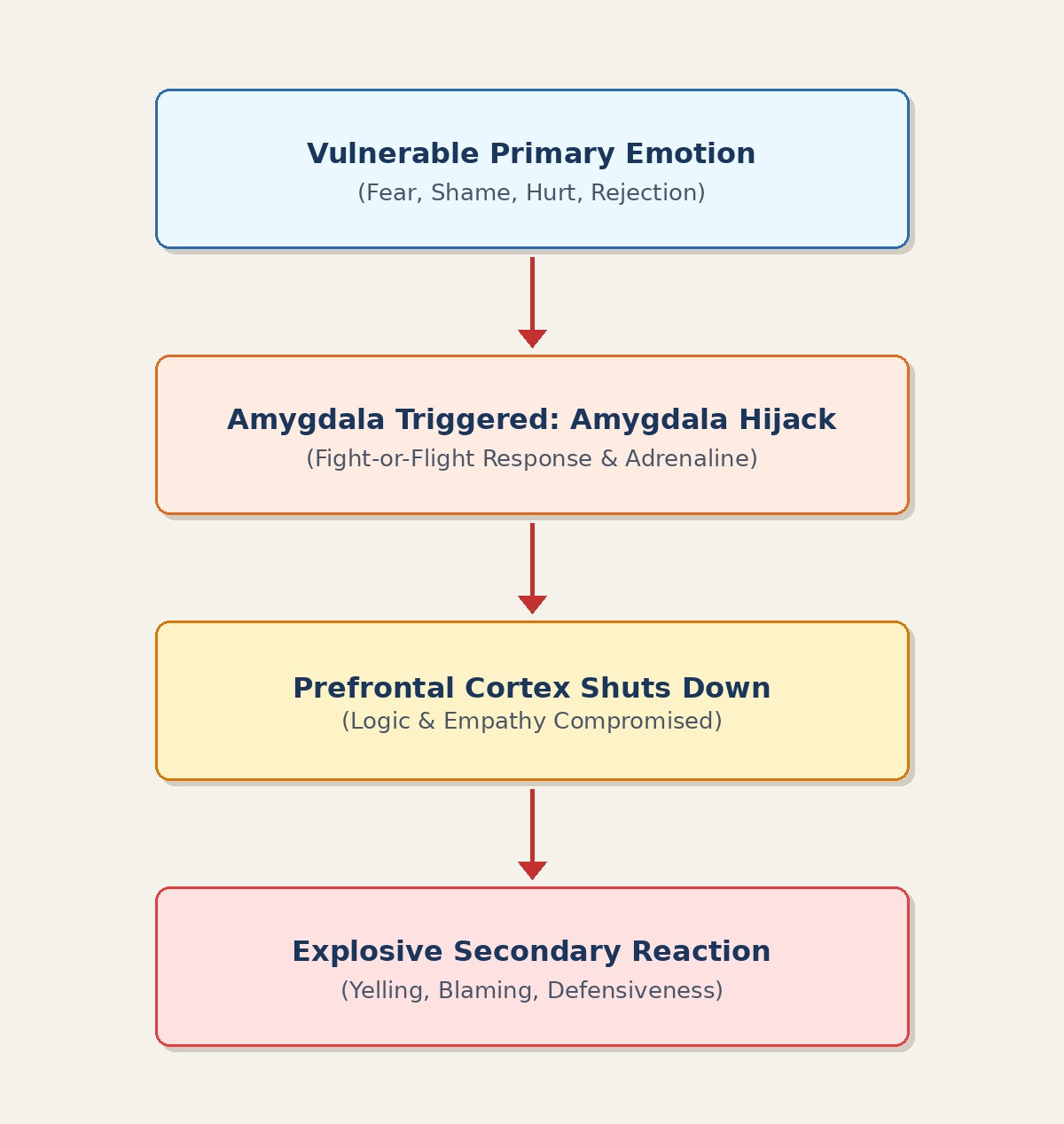
During what therapists call an "amygdala hijack," your physiology shifts instantly:
Stress hormones spike: Adrenaline and cortisol flood your bloodstream in milliseconds.
Heart rate rushes: Your pulse rapidly climbs above 100 beats per minute (BPM).
Logic shuts off: The prefrontal cortex, which is the part of your brain responsible for logic, self-control, and empathy, essentially goes offline.
When your heart rate crosses that 100 BPM threshold, your brain cannot distinguish between a real physical threat and a critical comment from your partner about the dishes or the budget. Your body enters survival mode, and it prepares you to fight.
5 Practical Anger Management Techniques for Couples
Stopping an explosion requires intervening on two levels: calming the body first, then shifting how the mind processes the interaction. Here are five concrete techniques I to break the reaction loop.
1. Build a Strict Cooling Down Protocol
Trying to work through a delicate relationship issue while your heart rate is racing and your logic center is offline is counterproductive. Nothing good gets solved when two nervous systems are in fight-or-flight mode.
Sit down with your partner during a peaceful moment and establish a clear time-out agreement:
Pick a neutral phrase: Agree on a simple phrase, such as "I feel flooded and I need 20 minutes to cool down."
Name a clear return time: Simply walking out of the room leaves your partner feeling abandoned and usually escalates their frustration. Always state when you will return to continue the conversation.
Do not mentally rehearse: Use your break to step entirely away from the argument. Go for a short walk, sit in a quiet room, or stretch. If you spend those 20 minutes constructing your next rebuttal, your body will stay in alarm mode.
2. Calming the Physical Alarm System
Your mind takes its cues from your body. When you manually slow down your physical signs of distress, you send a clear message back to your brain that you are safe.
Technique | How to Practice It | Physiological Mechanism |
Box Breathing | Inhale for 4 seconds, hold for 4, exhale for 4, hold for 4. Repeat 4 times. | Stimulates the vagus nerve, directly lowering your heart rate. |
Temperature Reset | Splash cold water on your face or hold a cold ice pack to your chest. | Triggers the mammalian dive reflex to drop high blood pressure quickly. |
Progressive Tension Release | Squeeze your fists or shoulders tightly for 5 seconds, then let go completely. | Releases built-up physical tension trapped in the body's muscles. |
3. Move From Blame to Specific Requests
When anger takes over, people tend to make broad, absolute statements about their partner. Sentences starting with “You always…” or “You never…” immediately put your partner on the defensive, turning a minor issue into a major argument.
Try restructuring your thoughts using this clear framework:
Describe the situation plainly: “When our plans change and I don’t hear from you...”
Share your underlying feeling: “...I start to feel anxious and stressed because I’m not sure what’s happening with our evening...”
Make a clear request: “...I’d really appreciate a quick text when you know you’re going to be late or our plans have changed.”
Notice how this approach focuses on the specific action and the real feeling, rather than attacking your partner's character.
4. Recognize Your Personal Warning Signs
Anger rarely appears out of nowhere like a lightning strike. It builds up in stages, leaving different clues in your body and mind along the way.
You can map out your emotional state using three distinct zones:
Green Zone (Balanced): You feel relaxed in your body. You are open to listening, curious about your partner's perspective, and able to think before responding.
Yellow Zone (Rising Heat): Your jaw clenches, your shoulders tighten, your voice starts rising, and you feel a strong urge to interrupt. This is your sign to pause and slow the conversation down.
Red Zone (Explosive): You experience tunnel vision, your chest feels tight, and you feel an overwhelming urge to shout or push back. In this zone, a formal time-out is mandatory.
Learning to catch yourself while you are still in the Yellow Zone is the key to preventing Red Zone explosions.
5. Uncover What Lies Beneath the Anger
Once a heated interaction has cooled down and both of you feel grounded again, spend some time looking closely at what triggered the intense reaction.
Ask yourself honest questions:
Did that comment make me feel unappreciated or useless?
Was I reacting to the present moment, or did this touch an old memory of feeling controlled/abandoned/uncared for?
Am I overwhelmed by stress in other areas of my life, like my career or finances?
Sharing these deeper realizations with your partner (e.g., “I think I reacted so strongly because, in that moment, I felt like you weren’t really hearing me”) turns a potential argument into an opportunity for genuine closeness.
When to Consider Professional Therapy
Self-guided techniques are wonderful daily tools, but ingrained patterns of anger often require professional support to fully untangle.
Working with a therapist can give you a safe, structured environment to understand where these reactions started and how to replace them for good.
You may want to consider professional support if:
Your anger leads to yelling, verbal insults, throwing objects, or physical intimidation.
You carry heavy guilt after disagreements, but feel unable to stop the pattern on your own.
Your partner has expressed fear, pulled away emotionally, or threatened to end the relationship.
Your reactions seem tied to past painful experiences, unresolved trauma, depression, or adult ADHD.
Rebuilding Trust and Moving Forward
Gaining control over your anger is not about burying your feelings, ignoring real problems, or pretending that everything is fine when it is not. It is about building the emotional strength to address real issues calmly, firmly, and respectfully.
Your relationship does not have to be defined by explosive fights and painful recoveries. With patience, practice, and the right guidance, you can create a home environment where both you and your partner feel safe, heard, and deeply valued.
Ready to Take the Next Step?
Healing relationship dynamics takes time, patience, and support.
If you’re beginning to notice how anger is affecting your relationship, it may be helpful to have a space to slow down, understand what’s underneath those reactions, and explore new ways of responding.
If you feel that talking with someone could be helpful, you’re welcome to learn more about therapy or reach out whenever you feel ready.


Comments